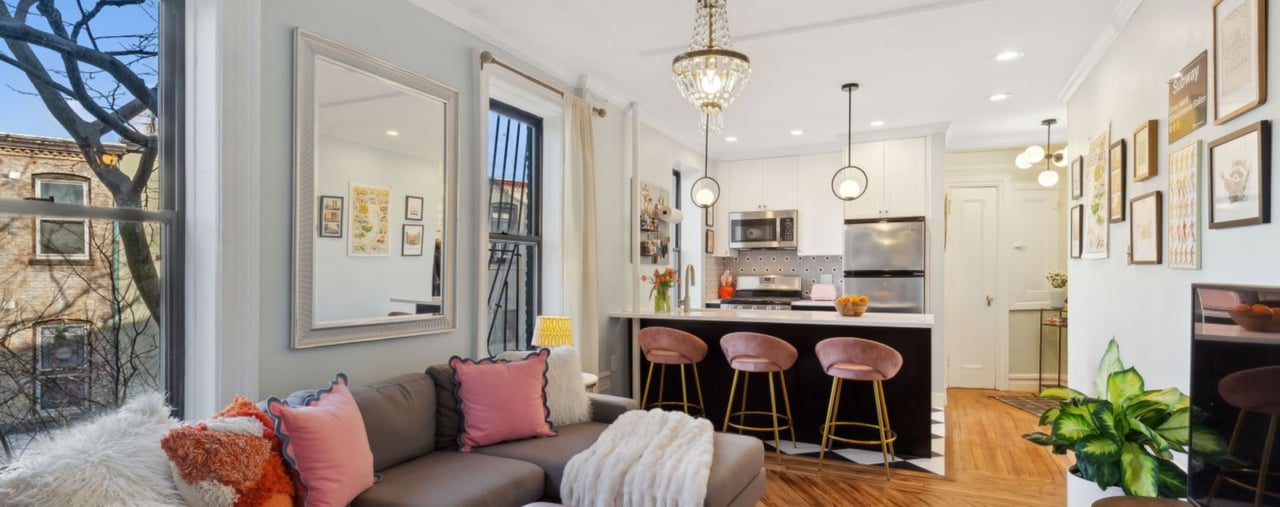
Prewar apartments are one of the reasons buyers are drawn to Prospect Heights.
High ceilings, hardwood floors, larger windows, established residential blocks and layouts with more character can make these homes feel distinctly different from newer Brooklyn condos. But buying prewar also requires a different kind of due diligence.
Danielle Nazinitsky’s buyer-side experience at 355 Saint John’s Place provides a useful example. Built in 1909, the four-story property is a boutique prewar condominium with just 16 residences. It was converted to condos in 2009 and sits close to Prospect Park, the Brooklyn Museum, Brooklyn Botanic Garden and Grand Army Plaza.
It represents a category of Prospect Heights property where buyers need to evaluate more than renovated kitchens and original details. Layout, building condition, maintenance history, carrying costs and even the number of stairs between the sidewalk and the front door can influence whether a prewar home is the right purchase.
355 Saint John’s Place: Prewar Character in a Boutique Condo
355 Saint John’s Place combines characteristics buyers often look for in Prospect Heights: a smaller building, prewar architecture and a location close to some of Brooklyn’s most important green and cultural spaces.
The property dates to 1909 and contains 16 residences across four stories. Building amenities include a landscaped outdoor area, bike storage, individual storage, laundry and an on-site superintendent. It is also pet-friendly.
Unlike many newer developments, however, it is a walk-up.
That distinction matters.
A walk-up can offer buyers an opportunity to own in a desirable neighborhood without paying for the extensive services and amenities of a newer elevator building. But the tradeoff needs to work for the buyer’s lifestyle.
Danielle’s buyer-side transaction at the property demonstrates experience with precisely this type of Prospect Heights purchase: an older building where understanding the property means looking at both its charm and its practical realities.
Why Buyers Want Prewar Homes
There is a reason “prewar” remains such a meaningful term in New York real estate.
Many older apartments offer proportions and architectural details that buyers find difficult to reproduce in new construction.
At 355 Saint John’s Place, apartments have been marketed with features including high ceilings, hardwood floors, oversized windows and abundant natural light. Larger residences in the building have also demonstrated how traditional prewar spaces can be updated with open kitchens, contemporary finishes and modern appliances.
That combination can be particularly attractive.
Buyers do not necessarily have to choose between historic character and contemporary living. A well-renovated prewar apartment can preserve the qualities that make an older home distinctive while updating the elements that affect everyday functionality.
But buyers need to know what has actually been renovated—and what has simply been covered with newer finishes.
Start With the Layout
When evaluating a prewar apartment, square footage is only part of the story.
Older buildings can have very different floor plans from contemporary developments. Some use space exceptionally well, with defined living and dining areas, substantial bedrooms and useful separation between rooms. Others may contain narrow hallways, small kitchens, awkward circulation or rooms that are difficult to furnish.
Buyers should therefore look at usable space rather than headline square footage.
Can the living room comfortably accommodate both seating and dining?
Are the bedrooms genuinely functional?
Is there enough storage?
Could walls be moved if the layout needs to change?
Does the apartment have multiple exposures?
Where are the plumbing lines and structural walls?
A thoughtful prewar layout can feel larger than its measurements suggest. An inefficient one can do exactly the opposite.
Charm Should Not Distract From Condition
Original details are valuable, but condition matters more than appearance alone.
Hardwood floors, moldings, high ceilings and old doors may immediately create an emotional connection during a showing. Buyers still need to understand what is happening behind the walls.
Electrical capacity is particularly important in older properties. Modern households place considerably greater demands on electrical systems than homes built a century ago were designed to handle.
Plumbing deserves similar attention.
Buyers should understand whether supply and waste lines have been updated, whether there is a history of leaks and whether renovations inside the apartment were completed properly.
Windows, heating systems, ventilation and signs of previous water damage should also be reviewed carefully.
A freshly renovated kitchen does not necessarily mean the building's underlying infrastructure is equally new.
Evaluate the Building, Not Just the Apartment
This is one of the most important lessons when buying prewar.
A beautiful apartment inside a poorly maintained building can become an expensive ownership experience.
Before purchasing, buyers should review the condominium or co-op's financial health, insurance, reserves, maintenance history and planned capital projects.
In a century-old property, questions about the roof, façade, masonry, plumbing, electrical systems, boiler, common areas, waterproofing and drainage become especially relevant.
Buyers should also investigate recent assessments and determine whether major work is anticipated.
The goal is not to find an old building where nothing will ever require maintenance. That is unrealistic.
The goal is to understand how responsibly the building has been maintained and whether upcoming costs are reasonably accounted for.
Walk-Up Living Is a Real Tradeoff
At 355 Saint John’s Place, there is no elevator.
That makes floor level an important part of the buying decision.
A second-floor apartment and a fourth-floor apartment in the same building can create very different daily experiences. Higher floors may offer better light, greater privacy and less street noise, but buyers need to be comfortable carrying groceries, luggage and everyday belongings upstairs.
The calculation can change again for buyers with children, strollers, pets or mobility considerations.
Walk-up apartments can sometimes provide relative value compared with elevator properties, but the discount only matters if the lifestyle works.
Resale should also be considered. Even if stairs are not a concern for the current buyer, they may reduce the future buyer pool.
Understand What Monthly Charges Cover
Prewar buyers should not compare properties solely on purchase price.
Monthly carrying costs can materially change the economics of ownership.
A smaller building may have relatively modest amenities but fewer owners sharing major expenses. A larger building may spread costs across more units but have additional staff, elevators and services to maintain.
Buyers should understand what common charges or maintenance actually include and whether the current amount realistically supports the building.
Low monthly charges are attractive.
Charges that are artificially low because maintenance has been deferred are not.
The building’s financial statements, reserves and history of assessments provide important context.
Prospect Heights Demand Adds Another Layer
The building itself is only half of the equation.
355 Saint John’s Place sits in a particularly desirable section of Prospect Heights, close to Prospect Park, Brooklyn Museum, Brooklyn Botanic Garden and Grand Army Plaza.
Transportation is another advantage. The Eastern Parkway–Brooklyn Museum 2 and 3 station is roughly 0.2 miles away, with additional subway options available around Grand Army Plaza, Seventh Avenue and Botanic Garden.
The surrounding neighborhood also gives buyers access to the restaurants, cafés and businesses along Washington and Vanderbilt Avenues.
That combination of historic residential streets, transportation, cultural institutions and Prospect Park helps sustain buyer interest in this part of Brooklyn.
It also means good prewar properties can face meaningful competition when they come to market.
Renovated vs. Unrenovated: Know What You Are Paying For
Prewar buyers frequently have another decision to make: buy renovated or take on the work themselves.
A turnkey apartment offers certainty and convenience, but the renovation premium may be substantial.
An unrenovated property can create an opportunity to customize the home, but buyers need a realistic budget.
Renovation costs extend beyond cabinets and finishes. Electrical upgrades, plumbing, flooring restoration, demolition, permits, architect fees and unforeseen conditions can quickly change the economics of a project.
Building rules matter too.
Before buying with renovation plans, buyers should understand alteration agreements, working hours, contractor insurance requirements, approval procedures and any restrictions on moving plumbing or changing layouts.
A property that looks like a straightforward renovation during a 20-minute showing may be considerably more complicated once building rules are considered.
What Buyers Should Inspect Before Purchasing
When Danielle works with buyers considering a Prospect Heights prewar property, the apartment needs to be evaluated as part of a larger system.
Buyers should pay particular attention to electrical capacity, plumbing, windows, floors, ceilings, signs of leaks or moisture, heating, ventilation, appliances and the quality of previous renovations.
At the building level, they should investigate the façade, roof, common areas, mechanical systems, financial reserves, insurance, assessments and history of major capital work.
Then there are the practical questions.
How many flights of stairs are involved? Where is laundry located? Is there dedicated storage? Is bike or stroller storage available? How are packages handled? What are the pet and renovation policies?
None of these questions is particularly glamorous.
Together, they can determine whether the apartment works long after the excitement of the purchase is over.
Local Experience Matters With Prewar Properties
Danielle Nazinitsky’s buyer-side experience at 355 Saint John’s Place adds another dimension to her work in Prospect Heights.
Her experience in the neighborhood spans both contemporary condominium properties and older prewar housing—two categories that require different approaches from buyers.
A newer condo might require close examination of amenities, sponsor history, common charges and construction quality.
A 1909 walk-up requires a different lens: building maintenance, aging systems, renovation quality, floor level, layout and long-term capital needs become particularly important.
Understanding those distinctions is part of understanding Prospect Heights itself.
Buying Prewar in Prospect Heights
The appeal of a Prospect Heights prewar home is easy to understand.
Buyers can find high ceilings, hardwood floors, generous windows and distinctive layouts on established Brooklyn blocks, often within walking distance of Prospect Park and some of the borough’s best-known cultural institutions.
But character should be the beginning of the evaluation not the end.
Danielle’s buyer-side experience at 355 Saint John’s Place demonstrates the importance of looking beyond the surface. A strong prewar purchase requires understanding the apartment's layout and condition, the quality and finances of the building, monthly ownership costs, renovation history and the practical realities of living in an older property.
For buyers considering a prewar home in Prospect Heights, Danielle Nazinitsky brings experience evaluating both sides of that equation: the character that makes these homes desirable and the details that determine whether they make sense as a purchase.